
Energietransitie: een fatamorgana
Follow@plattezaken en Facebook of Linkedin
Energietransitie: een fatamorgana.
(dit artikel is gepubliceerd op Climategate.nl, 24-11-2025)
Voormalig USA-klimaatgezant John Kerry merkte eens op: “There shouldn’t be any more coal-fired power plants permitted anywhere in the world.”
Dat doet me denken aan een uitspraak van de schrijfster Anais Nin: “We don't see things as they are, we see them as we are”.
Het lijkt er op dat de westerse wereld (behalve sinds 2025 de regering Trump) oog in oog staat met een fatamorgana: we zien een energietransitie die er niet is, althans niet in een relevante mate: zonne- en windenergie groeien qua omvang minder dan de jaarlijks toename in energievraag en -productie. En zolang fossiele brandstoffen goedkoper zijn dan zgn. "hernieuwbare energie" zal dat denk ik zo blijven.
Weliswaar zakt het percentage fossiele energie sinds 1965 heel langzaam (van bijna 100% naar nu 87%), maar de absolute hoeveelheid energie is in die 60 jaar verviervoudigd van 150 naar 600 exajoules.

Wereldwijd is de bijdrage van zon en wind aan de opwekking van energie slechts miniem en daarmee feitelijk irrelevant.
(NB: het zwarte deel in de grafiek is niet alleen fossiel, maar bevat ook kernenergie, waterkracht en andere niet fossiele energiebronnen )
Meer precies uitgesplitst naar energiebron zag het er in 2018 zo uit:

In 2018 dus 85% fossiel.
Het Energy Institute schrijft er in 2025 het volgende over in haar Statistical Review of World Energy:
“Since 2000, the world has spent about $10 trillion (in ons rekenstelsel 10 biljoen = 10 x 1 miljoen x 1 miljoen) on renewable energy, but hydrocarbons, like coal, natural gas, and oil, still provided 87% of world energy in 2024 (Bron hier).”
"Global coal consumption continues to rise. Today, more than 6,500 coal-fired power plants operate across the world, and another thousand are in planning or under construction.
The US has about 80 vehicles for every 100 people, but vehicle usage in Africa and India remains below 10 vehicles for every 100 people.
Today, developed nations use up to 20 times as much plastic as poor nations on a per-person basis.
Developing nations will continue to use more hydrocarbon fuels to enable their economies to grow.
Almost 700 million people do not have access to electricity, and another two billion have blackouts or brownouts every other day. Over two billion people do not have access to clean water. Millions die each year from malaria, typhoid, and other diseases.
World leaders should concentrate on these real problems, instead of unfounded concerns about carbon dioxide emissions.”
Bronnen:
Goreham, Steve, Paris Pact Fail: Climate Dogma Collides With Global Energy Reality; Ten years after the Paris Climate Agreement, Climatism is crumbling, ClimateChangeDispatch, 20-11-2025.
Statistical Review of World Energy, Energy Institute (2025).
Nawoord
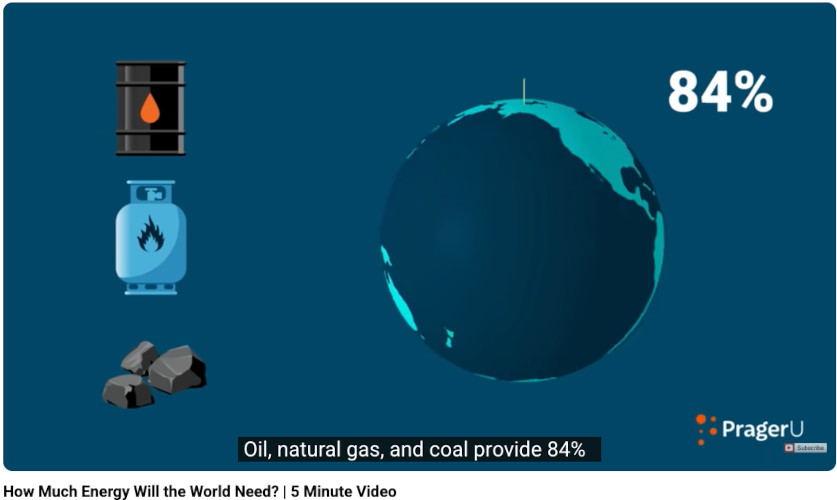
In reactie op bovenstaand artikel wees een commentator op de volgende 5 min. video van 28-3-2022, waarin bovenstaande cijfers ook nog maar eens worden getoond, alsmede het enorme beslag op mineralen-mijnbouw voor elctronica, waarbij China de absoluut dominante producent is. Tevens dat de electriciteits-behoefte sterk zal toenemen vanwege ontwikkelingen in de informatietechnologie.
Elektrische energieverbruik versus totaal energieverbruik in Nederland
Het CBS geeft het percentage “hernieuwbare energie” in 2024: Wind:6,4%; zon: 4,3%; warmtepompen: 1,6% en biomassa 6,7%. Wind en zon samen dus 10,7%, ruim 3x zo veel als mondiaal. Niet hernieuwbaar is 81% wat beter is dan mondiaal.
Echter, die 6,7% biomassa is voornamelijk houtstook, de meest perverse vorm van “hernieuwbare energie”, waar wereldwijd bossen worden gekapt. Als we die "would be" hernieuwbare energie niet als zodanig meetellen, komt ook Nederland in 2024 gewoon weer op ca. 87% niet hernieuwbare energie
Bovengenoemde cijfers en tekst zie je niet veel in de media. Daar wordt meer nadruk gelegd op de energiemix bij onze elektriciteitsvoorziening. Maar, zoals het CBS in bovenstaande link schrijft: “Van het totale energieverbruik, inclusief fossiele energie, is ongeveer de helft voor warmte en koude, ruim een kwart brandstof voor vervoer en iets minder dan een kwart voor elektriciteit.’
Veel cijfers en statistieken in de media slaan dus slechts op een kwart van onze totale energievoorziening. Het komt veel voor dat in de media wordt gesproken over “energie” als slechts “elektrische energie” wordt bedoeld. Dat is appels met peren vergelijken, maar het grote publiek trapt daar in. Immers het is allemaal fruit.
Gosselin, Pierre,
Fossil Fuel Demand Climbs As Green Transition Stalls; The need for hydrocarbons keeps rising despite climate targets and green energy promises, ClimateChangeDispatch, 24-11-2025
Enkele citaten hier uit:
A central problem is that renewable energies are currently not replacing conventional sources, but merely supplementing them. We are in a Phase of Addition.
Steady at least until 2040
Even in less dynamic models like the CPS scenario, the quantities of oil and gas remain stable well past 2040. Global oil consumption remains at around 100 million barrels per day.
This finding shows how deeply the market is permeated by fossil fuels, which remain the cornerstone of supply.
If renewables were really as good as many claim, then why have they failed to curb fossil fuel use? Obviously, they are nothing what their proponents claim them to be.
U bent hier: inhoudsopgave - energie - energietransitie: een fatamorgana
Deze website is een activiteit van dr. Hugo H. van der Molen, Copyright 2007 e.v.
Mail ons uw commentaar, aanvullingenen en correcties !
Follow @plattezaken en Facebook of Linkedin